
Chromatography

درباره سایت
آخرین مطالب
امکانات وب
Identify Carboxylic acids , amines and amino acids
Carboxylic Acids:

Determination of Equivalent Weight (or Neutralization Equivalent)
Molecular Weight Determination
Generally, any acid (or base) can be titrated using standard solutions of base (or acid). The neutralization equivalent obtained is usually a simple fraction of the molecular weight (1, 1/2, 1/3, etc). In the titration of an acid with standard base, the endpoint is reached when all the acid is neutralized and a drop of excess base is added. If phenolphthalein is used as the indicator, it will turn red at this instant. For a dicarboxylic acid such as malonic acid, the endpoint is reached when the last of the acid is converted to the carboxylate anion. The neutralization equivalent will be one-half its molecular weight....
CH2 (CO2H) 2 + 2 NaOH ----- CH2(CO2Na) 2 + 2 H2O
Equivalent weights must be done in duplicate and the values obtained should agree within a few percent. If not, do a third determination.
The equivalent weight (neutralization equivalent) can be calculated as follows:
V (ml) x M (mmol/ml)= wt (mg)/equivalent weight (mg/mequiv); V = volume of standard base used measured accurately to at least 3 significant figures; M= molarity of standard base as long as the base is monobasic, probably listed as 0.100M NaOH or KOH (note three significant figures); wt= weight of unknown used. An equivalent weight of 120 mg/mequiv means that the molecular weight is some whole number multiple of 120; for example, 120 (if monoacid there is 1 mequiv/mmol) or 240 (if diacid there are 2 mequiv/mmol) or 360 (if triacid), etc...
For Carboxylic Acids:
Neutralization Equivalent and Equivalent Weight of Carboxylic Acid:-
Procedure:
Weigh 0.2 g (to three significant figures) of the unknown carboxylic acid, and place in a
125-mL Erlenmeyer flask. Dissolve the acid in about 50 mL of water or aqueous ethanol
(the acid need not dissolve completely, because it will dissolve as it is titrated). Titrate
the acid, using a standardized solution of NaOH of known molarity (in the range of 0.1000 M) and a phenolphthalein indicator (2 drops). Note the equivalent point (colorless to pink color).
Record the volume of NaOH used. Duplicate the run.
Calculate the neutralization equivalent (NE) from the equation:
NE = mg of carboxylic acid/molarity of NaOH x mL of NaOH used
The NE is identical to the equivalent weight of the carboxylic acid. If the acid has only
one carboxyl group, the NE and the molecular weight of the acid are identical. If the
acid has more than one carboxyl group, the NE equals the molecular weight of the acid
multiplied by the number of carboxyl groups, that is the equivalent weight. The NE can be used much like a derivative to identify a specific carboxylic acid.
Many phenols are acidic enough to behave similarly to carboxylic acids. This is especially true of those substituted with electron-withdrawing groups at the ortho and para ring positions. These phenols, however, can be eliminated by the ferric chloride test or spectroscopy.
https://www.google.gr/url?sa=t&rct=j&q=&esrc=s&source=web&cd=1&cad=rja&uact=8&ved=0ahUKEwi38aPaquHQAhUFtRQKHT8TBu0QFggYMAA&url=http%3A%2F%2Fonline.sfsu.edu%2Fmsequin%2FC336-338%2FChem%2520336%2520Supplementary%2520Procedures%2520for%2520Derivative%2520Preparation.doc&usg=AFQjCNHoEgbSSvCgddTgpb4fI0hpuvsOAQ&bvm=bv.140496471,d.d24
Derivatives of Carboxylic Acids:
Chemical properties
: Background and Properties
The important classes of organic compounds known as alcohols, phenols, ethers, amines and halides consist of alkyl and/or aryl groups bonded to hydroxyl, alkoxyl, amino and halo substituents respectively. If these same functional groups are attached to an acyl group (RCO–) their properties are substantially changed, and they are designated as carboxylic acid derivatives. Carboxylic acids have a hydroxyl group bonded to an acyl group, and their functional derivatives are prepared by replacement of the hydroxyl group with substituents, such as halo, alkoxyl, amino and acyloxy. Some examples of these functional derivatives were displayed earlier.
The following table lists some representative derivatives and their boiling points. An aldehyde and ketone of equivalent molecular weight are also listed for comparison. Boiling points are given for 760 torr (atmospheric pressure), and those listed as a range are estimated from values obtained at lower pressures. As noted earlier, the relatively high boiling point of carboxylic acids is due to extensive hydrogen bonded dimerization. Similar hydrogen bonding occurs between molecules of 1º and 2º-amides (amides having at least one N–H bond), and the first three compounds in the table serve as hydrogen bonding examples
The last nine entries in the above table caot function as hydrogen bond donors, so hydrogen bonded dimers and aggregates are not possible. The relatively high boiling points of equivalent 3º-amides and nitriles are probably due to the high polarity of these functions. Indeed, if hydrogen bonding is not present, the boiling points of comparable sized compounds correlate reasonably well with their dipole moments.


http://www.chemsink.com/reaction/199760/
spot test:
Chemical properties
The reaction between ammonia and copper(II) ions
Copper(II) sulphate solution, for example, contains the blue hexaaquacopper(II) ion -[Cu(H2O)6]2+.
In the first stage of the reaction, the ammonia acts as a Bronsted-Lowry base. With a small amount of ammonia solution, hydrogen ions are pulled off two water molecules in the hexaaqua ion.
This produces a neutral complex - one carrying no charge. If you remove two positively charged hydrogen ions from a 2+ ion, then obviously there isn't going to be any charge left on the ion.
Because of the lack of charge, the neutral complex isn't soluble in water, and so you get a pale blue precipitate.
This precipitate is often written as Cu(OH)2 and called copper(II) hydroxide. The reaction is reversible because ammonia is only a weak base.
That precipitate dissolves if you add an excess of ammonia solution, giving a deep blue solution.
The ammonia replaces four of the water molecules around the copper to give tetraamminediaquacopper(II) ions. The ammonia uses its lone pair to form a co-ordinate covalent bond (dative covalent bond) with the copper. It is acting as an electron pair donor - a Lewis base.

The Physical Properties are:


The corresponding reaction with amines
The small primary amines behave in exactly the same way as ammonia. There will, however, be slight differences in the shades of blue that you get during the reactions.
Taking methylamine as an example:
With a small amount of methylamine solution you will get a pale blue precipitate of the same neutral complex as with ammonia. All that is happening is that the methylamine is pulling hydrogen ions off the attached water molecules

With more methylamine solution the precipitate redissolves to give a deep blue solution - just as in the ammonia case. The amine replaces four of the water molecules around the copper.

As the amines get bigger and more bulky, the formula of the final product may change - simply because it is impossible to fit four large amine molecules and two water molecules around the copper atom.
http://www.chemguide.co.uk/organicprops/amines/base.html
Hinsberg Test:
Chemical properties
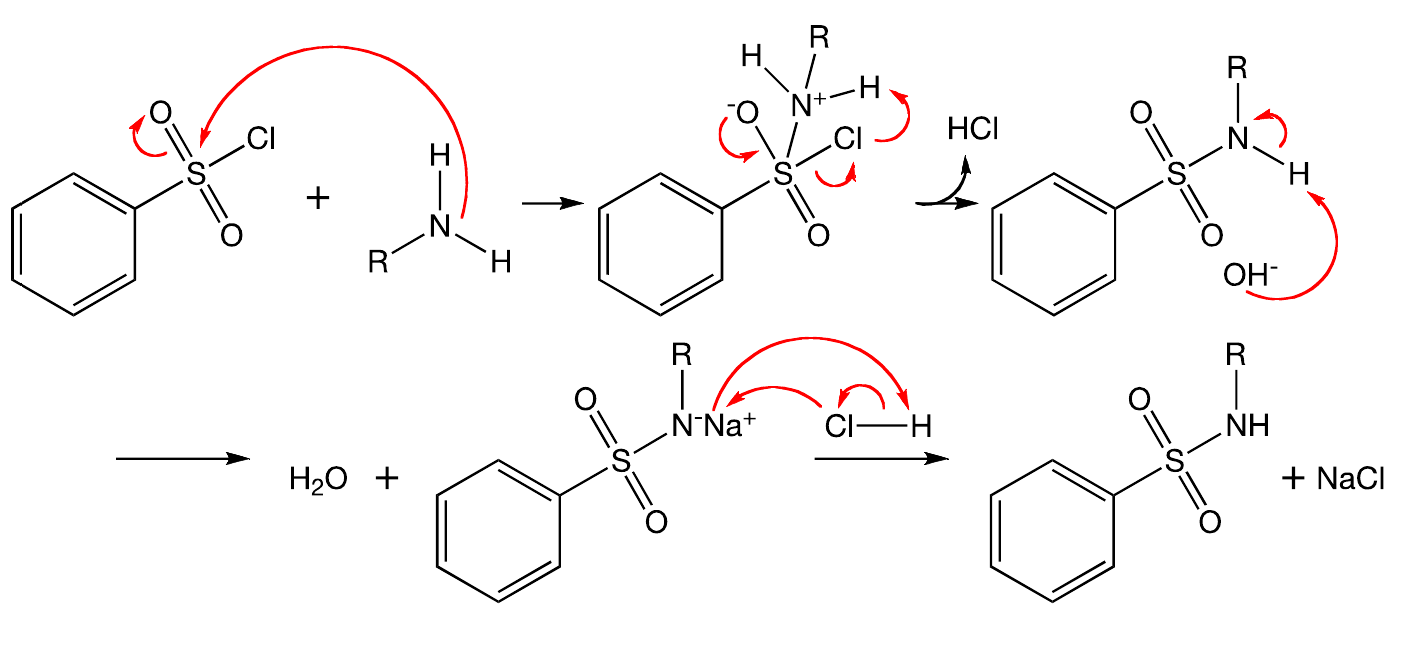
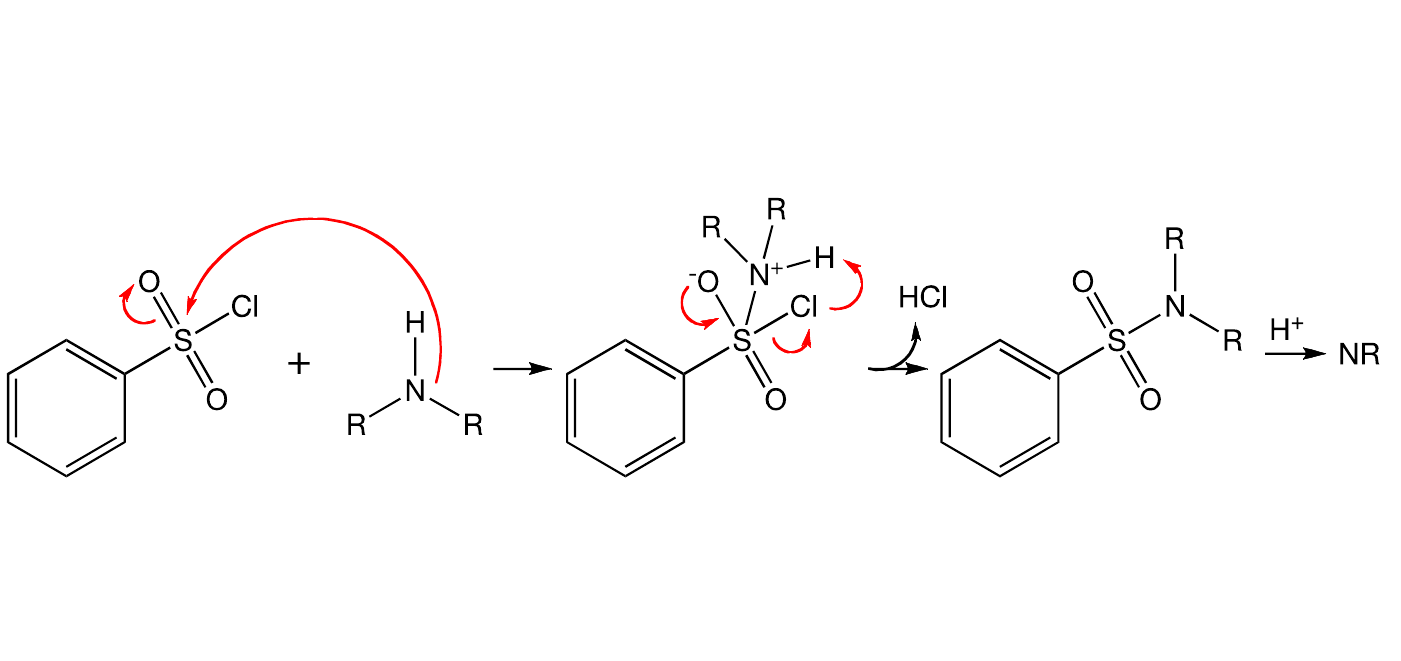
Another electrophilic reagent, benzenesulfonyl chloride, reacts with amines in a fashion that provides a useful test for distinguishing primary, secondary and tertiary amines (the Hinsberg test). As shown in the following equations, 1º and 2º-amines react to give sulfonamide derivatives with loss of HCl, whereas 3º-amines do not give any isolable products other than the starting amine. In the latter case a quaternary "onium" salt may be formed as an intermediate, but this rapidly breaks down in water to liberate the original 3º-amine (lower right equation).

The Hinsberg test is conducted in aqueous base (NaOH or KOH), and the benzenesulfonyl chloride reagent is present as an insoluble oil. Because of the heterogeneous nature of this system, the rate at which the sulfonyl chloride reagent is hydrolyzed to its sulfonate salt in the absence of amines is relatively slow. The amine dissolves in the reagent phase, and immediately reacts (if it is 1º or 2º), with the resulting HCl being neutralized by the base. The sulfonamide derivative from 2º-amines is usually an insoluble solid. However, the sulfonamide derivative from 1º-amines is acidic and dissolves in the aqueous base. Acidification of this solution then precipitates the sulfonamide of the 1º-amine.
https://www2.chemistry.msu.edu/faculty/reusch/virttxtjml/amine1.htm


Left to right: 1º amine, 2º amine & 3º amine

1º amine reacted
برچسب:
نویسنده: کامران حیدریان