
آخرین مطالب
امکانات وب
sodium test
The sodium fusion test is used in elemental analysis for the qualitative determination of the presence of halogens, nitrogen and sulphur in an organic compound. It was developed by J. L. Lassaigne.[1]
The test involves heating the sample strongly with clean sodium metal, "fusing" it with the sample. A variety of techniques has been described. The "fused" sample is plunged into water, and the usual qualitative tests are performed on the resultant solution for the respective possible constituents.[1]
The halogens, nitrogen and sulphur are covalently bonded to the organic compounds. In order to detect them, the elements need to be converted into their ionic forms. This is done by fusing the organic compound with sodium metal. The ionic compounds formed during the fusion are extracted in aqueous solution and can be detected by simple chemical tests. The extract is called sodium fusion extract or Lassaigne's extract.
When an organic compound is heated strongly with sodium, any halogens, nitrogen, and sulphur will be converted into inorganic sodium salts such as sodium halide (for halides), sodium cyanide (for nitrogen), sodium sulfide (for sulphur), and sodium thiocyanate (for sulphur and nitrogen).The nitrogen is confirmed with ferrous sulphate.
Factors error
This test is sensitive because the sodium bisulfite (reagent) dissolved in water so the water a milky color may not be possible or may not want to test aldehyde is dissolved in water or sodium bisulfate product that is completely soluble in water comes. in none of these cases does not answer the test easily.
Sodum test Factors Error: not a dry test tube, Vjvdnakhalsyhay containing active hydrogen which tested positive error.
Physical properties: release Gaz·hydrvzhn
Chemical properties: are forming hydrogen atoms attached to electronegative

https://en.wikipedia.org/wiki/Sodium_fusion_test
Cerric Nitrate Test
the alcohol complexes with the cerric nitrate ion
Three drops of the compound to be tested are added to 10 drops of an acidified cerric ammonium nitrate solution (a yellow solution).
Indications of a positive test:
The immediate formation of the red or red-brown color indicates a positive test. Note that if the unknown is not soluble in water, two layers will be present. A red color in either layer indicates a positive test.
a negative test (left) and a positive test (right

test cerric
Error factors:
1) phenol aldehyde need to test Jones respond.
2) tertiary alcohol contaminated samples
TEST JONS
jones test
The Jones Oxidation allows a relatively inexpensive conversion of secondary alcohols to ketones and of most primary alcohols to carboxylic acids. The oxidation of primary allylic and benzylic alcohols gives aldehydes. Jones described for the first time a conveniently and safe procedure for a chromium (VI)-based oxidation, that paved the way for some further developments such as Collins Reaction and which also enabled the oxidation of primary alcohols to aldehydes.
chrome (VI) Oxide is a very powerful oxidizing agent. When CrO3 oxidizes a material, the chromeis reduced. Thereduced Chrome has characteristic colors. This test shows presence of primaryandsecondary alcoholsand aldehydes no reaction with tertiary alcohols,ketones carboxylic acids or esters. phenols also react with jones reagent but do not produce a blue/green solution.
chemical properties
The use of high oxidant leads to errors.
Environment must be sulfuric acid, sulfuric acid, chromium increases the strength Oxidative
is the first in a milky solution of alcohol is not so.
Contamination of the tertiary alcohol.
PMID 4765859. https://en.wikipedia.org/wiki/Jones_oxidation
Locas test
Lucas' reagent is a solution of anhydrous zinc chloride in concentrated hydrochloric acid. This solution is used to classify alcohols of low molecular weight. The reaction is a substitution in which the chloride replaces a hydroxyl group. A positive test is indicated by a change from clear and colourless to turbid, signalling formation of a chloroalkane.[1] The test was reported in 1930 and became a standard method in qualitative organic chemistry.[2] The test has since become somewhat obsolete with the availability of various spectroscopic and chromatographic methods of analysis. It was named after Howard Lucas (1885–1963), an American chemist.
LOCAS
Error factors should be tested for alcohol. Otherwise the test solution does not work (due to the conversion of alcohol to the chloride
Lucas test: negative (left) with ethanol and positive with t-butanol
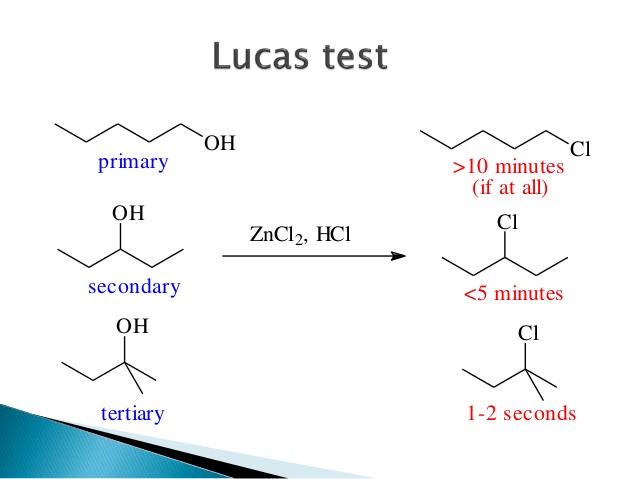
Lucas test in alcohols is a test to differentiate between primary, secondary, and tertiary alcohols. It is based on the difference in reactivity of the three classes of alcohols with hydrogen halides via an SN1 reaction:[3]
ROH + HCl → RCl + H2O
The differing reactivity reflects the differing ease of formation of the corresponding carbocations. Tertiary carbocations are far more stable than secondary carbocations, and primary carbocations are the least stable.
An equimolar mixture of ZnCl2 and HCl is the reagent. The alcohol is protonated by this mixture, and H2O group attached to carbon is replaced by the nucleophile Cl−, which is present in excess. Tertiary alcohols react immediately with Lucas reagent as evidenced by turbidity owing to the low solubility of the organic chloride in the aqueous mixture. Secondary alcohols react within five or so minutes (depending on their solubility). Primary alcohols do not react appreciably with Lucas reagent at room temperature.[3] Hence, the time taken for turbidity to appear is a measure of the reactivity of the class of alcohol, and this time difference is used to differentiate among the three classes of alcohols:
- no visible reaction at room temperature and forming an oily layer only on heating: primary, such as 1-pentanol
- solution forms oily layer in 3–5 minutes: secondary, such as 2-pentanol
- solution forms oily layer immediately: tertiary, such as 2-methyl-2-butanol
Lucas test: negative (left) with ethanol and positive with t-butanol
ما را در سایت Chromatography دنبال میکنید
برچسب: نویسنده: بازدید: 195